
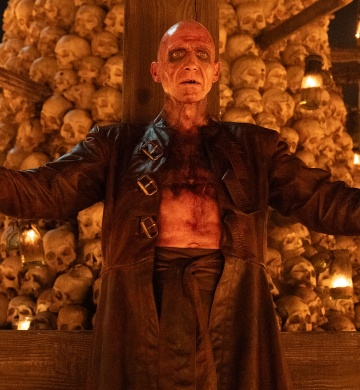
28 Years Later: The Bone Temple — Expanding the 28 Years Later Franchise
28 Years Later: The Bone Temple is the next major installment in the acclaimed 28 Years Later franchise — the long-awaited continuation of the groundbreaking 28 Days Later and 28 Weeks Later saga created by Danny Boyle and Alex Garland. As the direct sequel to 28 Years Later, this new chapter in the post-apocalyptic horror series unfolds immediately after the events of the 2025 film, continuing the harrowing story of survival in a society permanently transformed by the Rage Virus, infection, fear, and the complete collapse of all things normal.
Directed by Nia DaCosta, 28 Years Later: The Bone Temple pushes the long-running zombie-adjacent horror franchise into unsettling new territory — where the infected remain brutally lethal, but the true danger arises from the extremes of human nature itself in this uncertain future.
Where 28 Years Later: The Bone Temple Fits in the 28 Franchise Timeline
Since 28 Days Later (2002) redefined modern horror cinema with its stark depiction of the Rage Virus and the fury underpinning humanity, the 28 franchise has always been about more than fast-moving infected. Each installment — from 28 Days Later to 28 Weeks Later to 28 Years Later — has explored what happens when civilization collapses, and what grows in its absence.
28 Years Later shifted the lens to a world long bereft of functioning civilization, examining cycles of human behavior slowly re-emerging and mutating in the shadow of decades-long societal collapse following the Rage Virus outbreak.
28 Years Later: The Bone Temple represents a crucial turning point in that evolution. Under DaCosta’s skillful direction, the franchise expands beyond viral horror into a broader, more psychologically layered meditation on the extremes of human nature — the capacity for compassion and cruelty, love and hate — stretched to their limits in a post-apocalyptic wasteland. Fear is the new faith.
Enter the World of 28 Years Later: The Bone Temple
28 Years Later: The Bone Temple turns the world of 28 Years Later on its head, shifting the apocalyptic horror saga into darker, more psychologically unsettling terrain.
Unlike the punk-rock, lo-fi immediacy of 28 Days Later or the primordial, experimental edge of 28 Years Later, DaCosta’s film captures a more fully realized vision of long-term apocalypse. Under the lens of cinematographer Sean Bobbitt, the infected-scarred world feels settled yet menacing — grounded in a classical cinematic approach that highlights both the stark beauty and ever-present terror of a society reshaped over decades by the Rage Virus pandemic.
Composer Hildur Guðnadóttir delivers an atmospheric, sorrowful, and intensely immersive score that deepens that tension, threading a haunting emotional undercurrent through moments of quiet devastation and sudden brutality. Carefully chosen needle drops from Radiohead, Duran Duran, and Iron Maiden echo through the ruins like relics of a civilized world long transformed by outbreak horror.
In this strange new world, fear, obsession, and moral ambiguity define the rules of survival. Human conflict now overshadows even the threat of the infected, as loyalties, rituals, and extreme belief systems govern daily life in the post-Rage Virus era. Acts that appear charitable can conceal corruption, while acts of mutual survival may reflect genuine compassion. The infected remain ever-present — a relentless reminder of the virus’s reach — but it is the choices, obsessions, and extremities of the living that drive the tension and shape the society that has emerged in 28 Years Later: The Bone Temple.
Through this lens, the film presents a world both familiar and deeply disquieting: one where civilization’s rhythms are resurfacing, but the line between compassion and cruelty is razor-thin, and survival depends as much on navigating human psychology as evading infection.
New and Returning Characters in 28 Years Later: The Bone Temple
28 Years Later: The Bone Temple assembles a compelling ensemble cast navigating a world permanently altered by the Rage Virus outbreak.
At the center is Spike (Alfie Williams), a young survivor forced to rely on instinct and sharp judgment in a society where trust is fragile and danger constant. Opposite him stands Jimmy Crystal (Jack O’Connell), a volatile and magnetic force of chaos who represents a different kind of threat — one born not from infection, but from the darkest extremes of human behavior in this post-apocalyptic horror landscape.
Alongside him is Jimmy Ink (Erin Kellyman), a hardened warrior shaped by brutality yet quietly yearning for a future defined by compassion rather than fear. Dr. Kelson (Ralph Fiennes) wrestles with the scientific and moral complexities of understanding — and perhaps controlling — the infected and the long-term mutations of the Rage Virus. Meanwhile, the imposing Samson (Chi Lewis-Parry) embodies the rise of a new, survival-driven hierarchy in a world where traditional power structures collapsed decades ago.
As their paths collide, 28 Years Later: The Bone Temple constructs a high-stakes narrative in which every choice carries profound consequences — and where the danger posed by the living can be as immediate and terrifying as the infected themselves.
Expanding the Rage Virus Mythology
At its core, 28 Years Later: The Bone Temple preserves the defining pillars of the franchise: the relentless terror of the Rage Virus, the visceral tension of survival horror, and the moral reckoning that unfolds when civilization collapses under pandemic infection.
Yet this sequel pushes the mythology of the 28 Years Later universe into deeper and more ambitious territory. Rather than focusing solely on the mechanics of the virus or outbreak containment, the film explores the long-term psychological, cultural, and philosophical consequences of surviving for decades in a world shaped by trauma, fear, and generational memory of infection.
In this evolution of the 28 saga, the virus becomes only the beginning of the story. What emerges instead is a study of human behavior under extreme pressure — obsession, devotion, cruelty, empathy, and love coexisting in fragile balance. By widening its lens beyond traditional zombie horror conventions, 28 Years Later: The Bone Temple sharpens the franchise’s enduring question: in a world stripped to its most brutal extremes, what does it truly mean to be human?
What The Bone Temple Means for the 28 Years Later Franchise
28 Years Later: The Bone Temple preserves the core elements that have defined the franchise since 28 Days Later first changed modern horror cinema: the relentless threat of the Rage Virus, the breakneck tension of survival, and the moral stakes that arise when humanity is pushed to its limits.
But this chapter also expands the thematic and philosophical scope of the post-apocalyptic universe, exploring not only the physical consequences of infection, but the full spectrum of human behavior it exposes — from cruelty and fanaticism to compassion and sacrifice.
28 Years Later: The Bone Temple proves that survival is as much about the choices people make, and the capacity for both good and evil within them, as it is about the virus that started it all.
